Friday, March 17, 2017

Гражданином помойки Украины можно стать за $100 тысяч. Прикольно.

Украина как притон для международной мафии.
Вряд ли нормальному человеку потребуется гражданство Украины, Южного Судана, Северной Кореи или Сомали.
Даже если ему самому предложат за это $ 100 000.
Очевидно, что украинское гражданство за $ 100 000 прежде всего будет привлекательно для международной мафии - наркобаронов, боссов якудза, гангстеров и т.д.
Вроде пресловутого Вороненкова и его "марухи" Максаковой, перешедшей ему от "авторитета" А.И. Тюрина (он же "Тюрик", "Киномеханик").


Украинское гражданство теперь можно получить, инвестировав в экономику страны $100 тысяч.


Об этом говорится в распоряжении кабинета министров о введении квоты на иммигрантов в 2017 году.
Согласно документу, в этом году в страну могут иммигрировать 2,2 тыс. человек, которые являются супругами граждан Украины или их детьми, а также 1,1 тыс. человек, которые приходятся гражданам страны ближайшими родственниками. Еще 558 человек имеют право восстановить гражданство. 


Средняя месячная зарплата на Украине в 2017 году


Sunday, March 5, 2017

Why do Russians lime all trees in their cities? Почему в России белят все деревья в городах?


Объяснение аборигена, бывшего советского человека


Вопрос одного аборигена-совка: 

Когда и зачем белят деревья?

Ответ другого аборигена:

Деревья белят два раза в год - в апреле и в ноябре, причем белят как в городах, так и на огородах.

В городах это просто эстетично: вымытые дороги, очищенные от дерьма газоны, и побеленные деревья - всё это очень радует глаз (Cool).
В городах с животными (лоси, зайцы, грызуны и пр. ( - медведи, тигры, волки, олени, зубры, мамонты, росомахи... Oh those Russians... LOL, ) деревья белят для защиты от этих деревопожирателей. Белят обычно высотой до ожидаемого снежного покрова - чтобы какой-нибудь зайчик не смог достать до свежей и вкусной коры, стоя на снегу.

Чем белят деревья? Э
то смесь извести с водой и столярным клеем.


Мнение прогрессивных обитателей Российской Федерации


В России стоило бы перестать белить стволы деревьев


Владимир Пукиш


Наступили по-настоящему теплые дни, и работники коммунальных структур и дорожных организаций массово выходят на побелку известью деревьев на улицах и в парках населенных пунктов и вдоль дорог. Картина обычная для нас, не так ли? Но почему тогда я несколько раз слышал от иностранных гостей края недоуменный вопрос: а что это такое, зачем белят стволы деревьев?
Оказывается, обычай белить деревья (а еще телеграфные столбы и бордюрные камни), действительно бытует только в странах бывшего СССР. Нигде больше этим не занимаются.

Коммунальщики, занятые этим делом, на вопрос: «Зачем белить столы деревьев» обычно отвечают, что так растения "выглядят красивее". Кто-то вспоминает объяснения учителей, что «жуки и гусеницы не смогут ползти вверх по побеленному стволу», а кто-то просто пожимает плечами…

При этом, биологи категоричны в своем мнении: белить разные деревья известью не нужно.

Так, кандидат биологических наук Олег Колесник рассказал, что белить можно только молодые плодовые деревья, растущие в садах, у которых еще не сформировалась твердая кора, чтобы кору не грызли зайцы и чтоб весной на коре не появились солнечные ожоги.

Декоративные и дикорастущие деревья вообще белить не нужно.

В любом случае, белить деревья следует до появления на них почек и только натуральной краской, без добавления каких-либо химических примесей или клея. Такая краска должна смываться после двух-трех дождей.

У нас же на многих деревьях видна еще прошлогодняя побелка. Специалисты утверждают, что в такой краске были химические добавки, которые мешают древесине «дышать», вредят дереву и портят внешний вид его ствола.

Версию же о том, что на побеленные деревья не нападут насекомые, опровергает, к примеру, ежегодное летнее нашествие гусениц американской летней бабочки (те, у кого под окнами растут чинары, знают этот ужасный чавкающий звук).

И уж вовсе ненужным расточительством и уродованием эстетики городских ландшафтов является побелка электрических опор, столбов, бордюров и всевозможных придорожных камней.

Нигде в мире не покрывают краской или известью природный камень и другие природные материалы. Это лишь делает видимость упорядочения нами того, что создала природа.

Кажется, привычка эта пришла к нам из воинских частей (все служившие в советской армии помнят покраску зеленой краской травы и отмывание мылом плаца перед приездом очередного генерала). Туда же, считают некоторые историки, привычка эта могла вообще попасть из мест заключения.

Кажется, еще более уродливым является «украшение» наших дворов покрашенными старыми автомобильными шинами, используемых как мини-цветники или оборудование для детских площадок. Старая резина, как продукт химической промышленности, отнюдь не является полезным для организма материалом – в отличие от тех же деревянных песочниц или даже металлических турников и качелей.

Так что есть возможность сэкономить время и деньги коммунальщиков и перестать заниматься ненужной побелкой деревьев. 


Saturday, March 4, 2017

The web of relationships between Team Trump and Russia


By Philip Bump


In the most abstract sense, there is nothing noteworthy about a government official meeting with an ambassador from a foreign country.
When such an interaction becomes important is when that official is an ally of a presidential campaign that’s got a complex set of possibly inappropriate relationships with other representatives of that ambassador’s country — and when that official while under oath says he did not have communications with representatives of that country.
What we’re going to endeavor to do here is to parse out that complex set of relationships, using the information we have at hand. In this case, as you’ve hopefully ascertained, the country at issue is Russia and the campaign is that of President Trump. The official, of course, is Attorney General Jeff Sessions. And the ambassador is, at this point, the linchpin of a lot of the interactions between Trump and the rest of his team.
We’ll consider three Russian entities.
    Ambassador Sergey Kislyak. Russia’s man in Washington.
    The Russian government. Kislyak is part of this government, of course, but we’ll use this as a shorthand for interactions with President Vladimir Putin or other government agencies (who may or may not be known). Included here is RT, the Russia-backed and -based television network.
    Russian business interests. This encompasses everything from Rosneft, the Russian oil giant, to sketchy Russian oligarchs.
As for the American side, let’s start at the top and move outward through Trump’s network.
Donald Trump, president. Trump’s connections to Russian business interests are murky, thanks to his decision not to release his tax returns during the campaign. We know that the Miss Universe pageant was hosted in Moscow when Trump owned it and that he earned millions of dollars for doing so. We know, too, that he’s repeatedly explored real estate deals in the country. It’s not clear whether Trump has met Kislyak, though the ambassador attended a foreign policy speech Trump gave last spring and the reception that preceded it. We know now that Trump has been in communication with Putin — but he also claimed to have been in contact with representatives of the Russian president (and Putin himself) before the campaign.
Jeff Sessions, attorney general. Sessions’s relationship with Kislyak is well-established by now. This is a good point at which to note, though, that the existence of that relationship does not in any way imply wrongdoing by Sessions. It’s just part of the network we’re establishing.
Attorney General Jeff Sessions told reporters at the Justice Department, March 2, that he was recusing himself from any investigation having to do with President Trump's 2016 campaign. Here are key moments from that news conference.
Jared Kushner, adviser. Trump’s son-in-law (Ivanka’s husband) also met with Kislyak during the period between Election Day and the inauguration, according to the New York Times. Kushner also has some loose connections to Russian business interests, according to the Times, including an investment from tech investor Yuri Milner in a real estate investment company and a friendship with the wife of oligarch Roman Abramovich. (She was invited to the inauguration as Ivanka Trump’s guest.)
Michael Flynn, former national security adviser. Flynn had a number of contacts with Kislyak after Election Day, including attending that meeting between the ambassador and Kushner. (Flynn was forced to resign his position after it was revealed that his comments about the content of those meetings to Vice President Pence were falsehoods.) After resigning from the Defense Intelligence Agency in 2014, Flynn was invited to give a paid speech at a celbration of RT. He did so and joined Putin’s table for a related banquet.
Donald Trump Jr., son. The younger Trump visited France last October to speak to an obscure Russian group. In 2008, Don Jr., who works for the Trump Organization, famously told a real estate conference that “Russians make up a pretty disproportionate cross-section of a lot of our assets” and that “we see a lot of money pouring in from Russia.”
Paul Manafort, former campaign manager. Manafort’s links to Russian interests are well established. New revelations that emerged during the campaign prompted Trump to demand Manafort’s resignation. Manafort is one of the Trump campaign staffers who reportedly made contact with Russian interests during the campaign.
Rex Tillerson, secretary of state. Before he was confirmed to serve as the head of the State Department, even Republicans questioned Tillerson’s relationship to Putin. As the head of ExxonMobil, Tillerson helped negotiate a massive agreement between the Russian government and ExxonMobil-Rosneft, a partnership between the two companies. Tillerson was subsequently awarded the “Order of Friendship” by Putin.


Tuesday, February 28, 2017

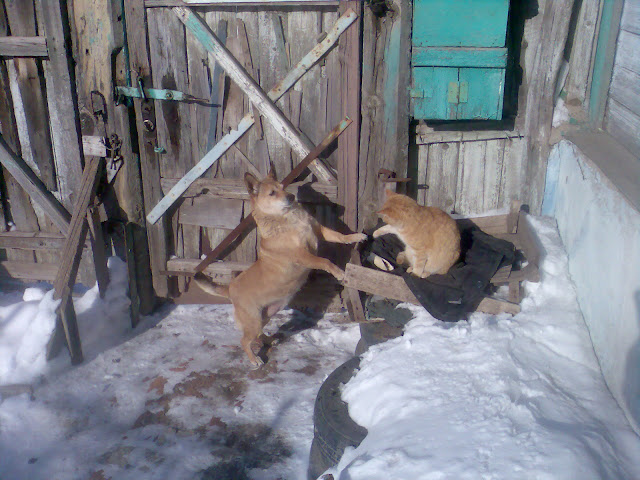
The cat & the dog

Оn a sunny winter day, the she cat of my sister was basking in sun rays. The she dog also had wished to bask in sun beside her. The cat at first resisted but at last they settled peacefully together.


Saturday, November 12, 2016

Back to Middle Ages - Donald Trump will introduce widespread tortures in the USA


Waterboarding Is One of Trump's Top Five Presidential Priorities


Donald Trump said in the past that he wanted to bring back waterboarding "and a hell of a lot more." Now, just one day after he was elected, it looks like he's still planning on following through with that promise, according to CNN.
CNN says that Trump's top priorities aren't jobs, or the economy, and sure as hell not reproductive rights or reducing carbon emissions. To give you an idea, waterboarding makes the list, right below building the Infamous Wall and improving ties with Russia.
As if that's enough, Senator Tom Cotton also told CNN's Wolf Blitzer that "waterboarding isn't torture" and that "Trump is a pretty tough guy and he's ready to make these tough calls." 


(CNN) - Waterboarding isn't torture, Republican Sen. Tom Cotton said Wednesday, aligning himself with President-elect Donald Trump's previously stated position.
"Waterboarding isn't torture. We do waterboarding on our own soldiers in the military," Cotton argued with CNN's Wolf Blitzer on "The Situation Room."
Blitzer interjected, "But the US doesn't do it anymore."
"If experienced intelligence officials come to the President of the United States and say we think this terrorist has critical information and we need to obtain it and this is the only way we can obtain it -- it's a tough call. But the presidency is a tough job. And if you're not ready to make those tough calls, you shouldn't seek the office. Donald Trump's a pretty tough guy, and he's ready to make those tough calls," Cotton said.
Blitzer reminded Cotton of his colleague Sen. John McCain, who himself was tortured as a POW during the Vietnam War, and says that torture is a violation of the Geneva Conventions and International Law.
"On this one, I disagree," Cotton said, "Anything that American troops volunteer for, and radio DJs volunteer for, is not torture. If it has to be done to save American lives, that's a tough call."
On the campaign trail, Trump repeatedly advocated for waterboarding terror suspect and wants to "broaden" existing laws to allow interrogators to use the tactic.
"We have to play the game the way they're playing the game. You're not going to win if we're soft and they're, they have no rules," Trump told CBS' "Face The Nation" in an interview taped in March.


Friday, November 11, 2016

Due to Donald Trump the fascist-communist regime in Russia and Putin's power will be strengthened and will become much more cruel


Donald Trump’s Victory Promises to Upend the International Order


By Peter Baker 


American white working people are the main supporters of Donald Trump and Putin's KGB fascist-communist Russia. The working class of Karl Marx is the main base and cause of all totalitarian fascist and communist regimes. 


American white women did much for Trump and Putin also. White women overall voted for Donald Trump by a decisive margin, and white women without college degrees broke even more heavily for the Republican nominee, according to exit polls.


Donald J. Trump’s stunning election victory on Tuesday night rippled way beyond the nation’s boundaries, upending an international order that prevailed for decades and raising profound questions about America’s place in the world.
For the first time since before World War II, Americans chose a president who promised to reverse the internationalism practiced by predecessors of both parties and to build walls both physical and metaphorical. Mr. Trump’s win foreshadowed an America more focused on its own affairs while leaving the world to take care of itself.

The outsider revolution that propelled him to power over the Washington establishment of both political parties also reflected a fundamental shift in international politics evidenced already this year by events like Britain’s referendum vote to leave the European Union. Mr. Trump’s success could fuel the populist, nativist, nationalist, closed-border movements already so evident in Europe and spreading to other parts of the world.
It is hardly surprising that much of the world was rooting for Hillary Clinton over Mr. Trump, who characterized his foreign policy as “America First.”
He promised to build a wall along the Mexican border and temporarily bar Muslim immigrants from entering the United States. He questioned Washington’s longstanding commitment to NATO allies, called for cutting foreign aid, praised President Vladimir V. Putin of Russia, vowed to rip up international trade deals, assailed China and suggested Asian allies develop nuclear weapons.

Polls indicated that Mrs. Clinton was favored in many countries, with the exception of Russia. Last summer, the Pew Research Center found that people in all 15 countries it surveyed trusted Mrs. Clinton to do the right thing in foreign affairs more than Mr. Trump by ratios as high as 10 to one.
Mr. Trump’s promise to pull back militarily and economically left many overseas contemplating a road ahead without an American ally.
“The question is whether you will continue to be involved in international affairs as a dependable ally to your friends and allies,” said Kunihiko Miyake, a former Japanese diplomat now teaching at Ritsumeikan University in Kyoto. “If you stop doing that, then all the European, Middle Eastern and Asian allies to the United States will reconsider how they secure themselves.”

In Germany, where American troops have been stationed for more than seven decades, the prospect of a pullback seemed bewildering. “It would be the end of an era,” Henrik Müller, a journalism professor at the Technical University of Dortmund, wrote in Der Spiegel. “The postwar era in which Americans’ atomic weapons and its military presence in Europe shielded first the west and later the central European states would be over. Europe would have to take care of its own security.”
“Trump’s presidency will make the U.S. sink into a full-blown crisis, including an economic one,” said Vladimir Frolov, a Russian columnist and international affairs analyst. “The U.S. will be occupied with its own issues and will not bother Putin with questions.”
“As a consequence,” he added, Moscow will have a window of opportunity in geopolitical terms. For instance, it can claim control over the former Soviet Union and a part of the Middle East. What is there not to like?”

Israel was another place where Mr. Trump enjoyed some support, mainly because of the perception that he would give the country a freer hand in its handling of the longstanding conflict with the Palestinians. But Prime Minister Benjamin Netanyahu and other Israeli leaders and commentators worried about a broader disengagement from a Middle East awash in war, terrorism and upheaval.
“Decisions cannot be postponed,” said Yohanan Plesner, a former member of the Israeli Parliament now serving as president of the Israel Democracy Institute. “The situation in Syria is very chaotic. The unrest in the region is continuing. America has to decide whether it wants to play an active role in shaping the developments of the region.”
And even some countries that might expect to see some benefits from an American retreat worried about the implications. Counterintuitive as it might seem, China was concerned about Mr. Trump’s promise to pull American troops back from Asia.
“If he indeed withdraws the troops from Japan, the Japanese may develop their own nuclear weapons,” said Shen Dingli, professor of international relations at Fudan University in Shanghai. “South Korea may also go nuclear if Trump cancels the missile deployment and leaves the country alone facing the North’s threats. How is that good for China?”
For American voters, that was not the point. After decades of worrying about what was good for other countries, they decided it was time to worry about what was good for America. And Mr. Trump promised to do just that, even if the rest of the world might not like it.


Donald Trump’s Campaign Stands By Embrace of Putin


Sept. 8, 2016

By Jonathan Martin and Amy Chozick 


Donald J. Trump’s campaign on Thursday reaffirmed its extraordinary embrace of Russia’s president, Vladimir V. Putin, signaling a preference for the leadership of an authoritarian adversary over that of America’s own president, despite a cascade of criticism from Democrats and expressions of discomfort among Republicans.
In a fashion that would have been unheard-of for a Republican during or immediately after the Cold War, Mr. Trump has made improved relations with the Kremlin a centerpiece of his candidacy.
While railing against Asian, Latin American and Middle Eastern countries, Mr. Trump has continually praised Mr. Putin’s government: He has hailed Mr. Putin’s tight control over Russian society, hinted that he may not defend the NATO-aligned Baltic nations formerly in Moscow’s sphere of influence, and for a time employed a campaign chief with close ties to Ukraine’s pro-Russian forces.
Hillary Clinton excoriated Mr. Trump for asserting that Mr. Putin is a better leader than President Obama, saying it was “not just unpatriotic and insulting to the people of our country, as well as to our commander in chief — it is scary.”
She seized on Mr. Trump’s assertion in the televised forum that Mr. Putin’s incursions into neighboring countries, crackdown on Russia’s independent news media and support for America’s enemies were no more troublesome than Mr. Obama’s transgressions. She said it showed that, if elected, Mr. Trump would be little more than a tool of Mr. Putin.
“It suggests he will let Putin do whatever Putin wants to do and then make excuses for him,”
Mrs. Clinton told reporters Thursday morning at Westchester County Airport in New York.